Sunday, September 3, 2017

Robe Maker to Kings and Queens


When I was planning my trip to London last year, I knew that I wanted to spend some time exploring the "temple" area in London where so much of the legal profession is housed and so much history is to be found.  While doing my planning research, I stumbled on to some information about a business called Edes & Ravenscroft.  What caught my eye was the fact that they made those wigs that barristers and judges wear in the British courtrooms.


I decided that since I would be in the neighborhood anyway, a quick visit to their store might also be interesting.


I wasn't disappointed.  Edes and Ravenscroft is thought to be the oldest firm of tailors in the world.  They can trace their roots back to 1689 when they were making wigs and ceremonial robes for the royal family.  They created the coronation robes for Their Majesties William and Mary.


Today they continue the tradition, making wigs for the legal profession as well as the silk robes used in courtroom settings.  In addition, they hold 3 Royal Warrants, one form Queen Elizabeth, one from the Duke of Edinburgh and one form the Prince of Wales.


I do love learning about these little bits of English culture.  I guess that makes me a true anglophile.

Sunday, August 27, 2017

Spectacular Views & Wonderful Art


Laguna Beach California offers some pretty spectacular ocean views from various places around the city.  It seems like everywhere you go there is an amazing view out over the Pacific.


The city is also a mecca for art.  There is public art all over the city and of course all summer long there are art festivals running in at least two locations.  On my recent trip, I discovered this very unique bench that was donated by the Inn at Laguna Beach and is a memorial for someone named Les Schroeder.  I loved the quote on the memorial:  "Like a fine wine he reached his prime".


Just behind the bench was this sculpture of a young woman letting her colorful scarf blow with the ocean breezes.


The Laguna Beach Fine Arts Festival goes on all summer long at their permanent space against a canyon wall.  The festival features the works of 140 top-notch artists.  This festival has a long history, it's been going on for 85 years.


This statue was located at a busy intersection near the festival grounds.


This modern sculpture blends in perfectly with the public building behind it.


On one corner where a bus stop is located I saw a set of these colorful stools that people can use while waiting for the bus.


I even found a pretty little fountain and plants at the delivery entrance to local business.  It's in a location that doesn't see much foot traffic so I'm glad I spotted it.


Laguna Beach has numerous art galleries all along the Pacific Coast Highway and the narrow streets of the business district.  Peeking in the door of this gallery I was greeted by this scary looking figure.  It was so scary that it terrorized a small child so much, his mother had to take him out.

Even if you only spend a day in Laguna Beach, there is an abundance of art to be seen when you step away from those ocean views.

Sunday, August 20, 2017

Tuzigoot


Tuzigoot National Monument is a pueblo style, ancient ruins located in central Arizona.  You might remember a post I did two years ago about Montezuma's Castle, a cliff dwelling located in northern Arizona.  It is believed that the Tuzigoot pueblo was built around the same time and by the same Sinagua peoples.  However, this structure is completely different.  Rather than being built on the side of a cliff, the pueblo was built on the top of a hill.


As you approach Tuzigoot, you can see the stone walls crowning the very top of the hill.  The location offered views in every direction which would give the people living there a sense of security.


And, the Verde River flows through the valley below providing water, the key ingredient for life.  You can see the green area below where the river has made the desert a lush green.


There are paths leading all through the ruin with lots of descriptive signs to explain the building and farming methods.
The site gets it's name from an Apache worker on the excavation team after the site was discovered.  Tuzigoot translates to "crooked water" in the Apache language and since the river makes a turn in the valley, it seemed an appropriate name.


The site was excavated in the 1930's by out of work miners and WPA workers.  The men did most of the digging and women were employed to put the pieces of pottery shards together.  It was like working a puzzle and in the end they had numerous vessels that were used to store grain and carry water.


The visitor's center for this National Monument contains a museum full of artifacts found in the area. On some days, like the day I was there, an archeologist gives talks to explain the living conditions at the site and the the cultural differences between this group of people and the people living many miles to the north of them.  I love how the visitor's center is built of the same stones found in the area so it blends in well with the historic walls just a few feet away.

Sunday, August 13, 2017

A Historic Railroad Line


Back in 1901, the Atchison, Topeka and Santa Fe Railroad built a spur from Williams Arizona to the Grand Canyon making the 64 mile trip much easier for those pioneer travelers who wanted to see this famous canyon they were hearing about.  The railroad continued operation until 1968 when competition from the automobile finally closed the railroad to passengers.  The line continued to be used for freight up until 1974 when even that service ceased because of the speedier service on the highway.  In 1988 Max and Thelma Biegert bought the line and began restoration, opening for passenger service once again in September of 1989.


I had heard from many people that the trip via train was something to experience so I decided it was about time I climbed aboard, so to speak.


The trip is now done not so much as an efficient way to get to the canyon but, rather a historic experience to give the traveler a little sense of what traveling to the canyon must have been like at the beginning of the twentieth century.


The trip to the canyon begins at the train station in Williams Arizona where travelers are invited to see a little preview show that sets the stage for a wild west adventure.


Several cowboys plan their day's activities and discuss a few misdeeds that might happen along the way.


Then everyone boards the train we set off on the slow trip to the Grand Canyon.  And, when I say slow, I do mean slow.  It takes about 2 1/2 hours to go those 64 miles but, the owners of the train have lots of entertainment available for the passengers to help pass the time.


We were treated to singers and story tellers along the way.


The car I was riding in was fairly close to the engine so I couldn't get one of those sweeping train photos when we rounded bends in the tracks.  This little peek at the engine will have to do.


Once we arrived at the Grand Canyon station I was able to get a photo that shows most of the train as it sat on the tracks.  Many people were going to stay a night or two at the canyon but, my goal was to just experience the train so I only spent the day there before heading back.


On the trip back to Williams later in the day, we got to experience an old fashioned train robbery with these desperadoes climbing aboard to "rob" the passengers.


You can see from the photo that no one appears to be really frightened.  In fact most people took out a dollar or two and offered it up to those masked men.  

It was a fun day and a unique experience.  I can see that it would be lots of fun for families and even groups of friends.  The train offers several classes of service from very basic to luxury class.  There is even a couple of observation cars available.  You can check out the possibilities on the Grand Canyon Railway website.  

Sunday, August 6, 2017

Historic Grand Canyon Hotel


When I was planning my northern Arizona road trip, I knew that I would be spending one night in Williams before traveling on to the Grand Canyon so I started my search for a place to stay.  There is no shortage of big, modern motels in Williams but if you've followed my blogs for any length of time you might know that I tend to seek out the historic places.


I do love checking out the historic hotels that are found all over the United States.  The only such place I could find in Williams was The Grand Canyon Hotel, a two story building dating back to 1891 and making it the oldest hotel in Arizona.


When it opened back in 1891, it was the only hotel close to the Grand Canyon so it was the logical place to stay for those hardy pioneer travelers who wanted to see that famous canyon.


The hotel closed in 1970 after the interstate highway bypassed Williams and the building stood empty for 35 years.  In 2004 it was purchased and the restoration and remodeling work began.  It opened again for business in 2005 with all new electric wiring, plumbing, paint and a new roof.  The rooms are small as you might expect from such an old hotel but, my room was quite comfortable.  When I first checked in, I was a bit worried about air conditioning but, you might be able to see that portable air conditioner over there by the window.  I turned it on and it cooled the room to perfection in a matter of minutes.


The bathroom even came with an old claw-footed bath tub!


The hotel was full of antique furniture and wonderful old photographs.  This photo shows the second floor landing.


In the afternoon a horse and carriage was parked outside and offering rides around the historic city with a little bit of western flare.


And, in the evening, the lobby was aglow from all the neon lights along Route 66 just outside the door.  Staying here was a great experience and since some of the hotel's past guests included General Pershing, The Vanderbuilts, the King of Siam and John Muir, I was in some very good company.

Sunday, July 30, 2017

The Mother Road


It's sort of ironic that the same day I'm writing this post, I heard a story on the radio about a push to designate Route 66 as a National Historic Trail.  Currently there is a preservation fund supporting Route 66 cities but the funding source is due to expire in 2019.  Designation as a historic trail will keep the funding going that helps to keep all the cities that were bypassed by Interstate 40 alive and able to preserve their history.


I spent the night in Williams before going to the Grand Canyon recently and enjoyed walking around the city and taking in all that historic Route 66 atmosphere.  Pete's Gas Station Museum preserved those old-fashioned gasoline pumps as well as antique autos, signs, tools and other things that we used to see in gas stations in the days gone by.


This Cruiser Cafe also known as the Grand Canyon Brewing Company is all decked out in Coca-Cola red.  As I was setting up this photo, that guy in the red car pulled up and parked adding another bright red touch to mirror the elevated red car.


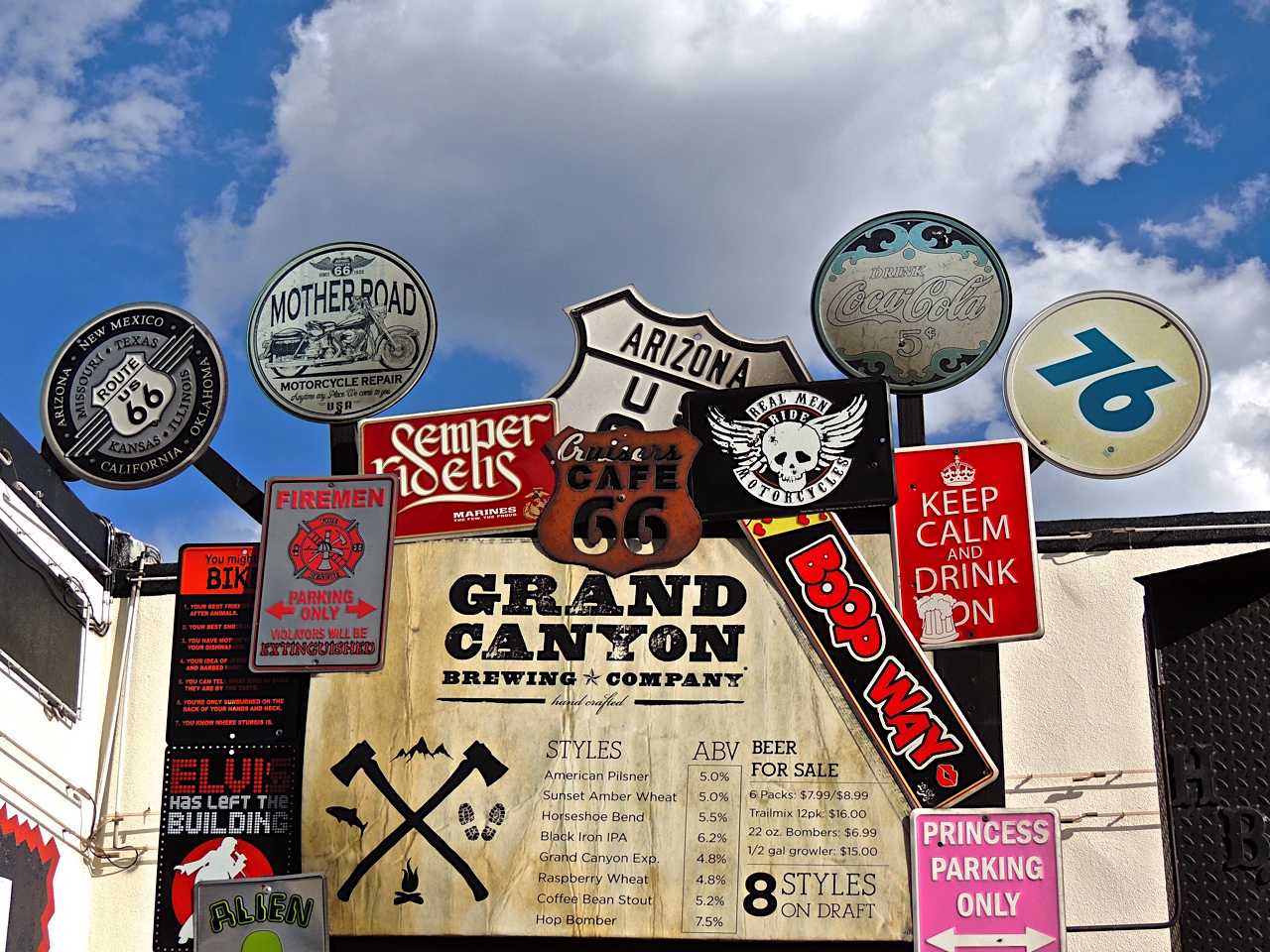
In front of the cafe is a menu board adorned with all kinds of signs some with a Route 66 theme and some with a little bit of an international theme.  Notice the "Mother Road" sign at the top left.  Route 66 is called The Mother Road because it stretches from Chicago Illinois all the way to Las Angeles California and was the main road used by travelers crossing the country before Interstate highways existed.  You might call it the original interstate highway.


I chose to have dinner at the Red Raven right next door to my hotel, The Grand Canyon Hotel.  (I'll have another post about my stay at that historic hotel.)


I had an excellent dinner that was enhanced by the friendly service.


And while I was eating, I enjoyed looking around the dining room full of all kinds of antiques.


After dinner I did some more exploring getting a kick out of all the neon lights and the hundreds of Route 66 signs.


The Mother Road runs right through the heart of town and back in the days before Interstate 40 by-passed the town, all travelers would have passed right through the town and many would stop for a meal or to spend the night.


Before heading back to my hotel, I stopped at the Grand Canyon Winery, a wine bar that featured a huge selection of Arizona wines.  I enjoyed talking to the young bar tender who was going to be moving to California in just a few weeks.

Then it was back to the hotel for a good nights sleep.  It seemed perfectly normal for a cowboy to be sitting on the bench outside the hotel door.  Even though he was checking his smart phone instead of tying up his horse, it was one last reminder of the history of this great little town.