Sunday, July 31, 2016

Flavors of Tucson


Whenever I travel to Tucson, there is one place that I always visit.  Even if I'm just passing through on my way to somewhere else, I can't resist the pull of this place.  It's El Carro Cafe in the historic downtown location.  Ever since I first discovered the place, it keeps calling me back.


El Charro Cafe is America's oldest family operated Mexican Restaurant.  The restaurant began in 1922 when Monica Flin set into motion a plan to succeed in her home town of Tucson.  She was at a bit of low point in her life after her first husband left her and her second husband passed away.  It was very hard in the beginning.  She operated on what her family calls "very short-term credit".  When  a customer arrived, she ran next door to the market to get what she needed, ran back and prepared the food, served it and collected her fee and then ran next door to pay the grocer.  Back then, dinner only cost fifteen cents.


Her reputation for good food became quickly known and the restaurant started to prosper.  The family today describes Monica as a larger than life, even flamboyant figure who wore stylish hats and was accompanied by her pet parrot when she greeted guests.  The location of the restaurant changed three times before settling into the old family home that was built by her father just outside of the Spanish Presidio which is located in the downtown area of present-day Tucson.


When Monica retired, she turned the restaurant over to her niece Zarina and Zarina's daughter Carlotta and husband Ray Flores began to operate the restaurant.  After Carlotta's father suffered a heart attack and was put on low-fat diet, Carlotta re-worked the family recipes to make everything they serve more heart-healthy while still keeping the strong flavors of its ethnic heritage.


The inside of the restaurant is decorated with a collection of Mexican art and artifacts.  And you can tell you are in a historic building from the small dining rooms to the way the floors creak a bit when you walk across the room.
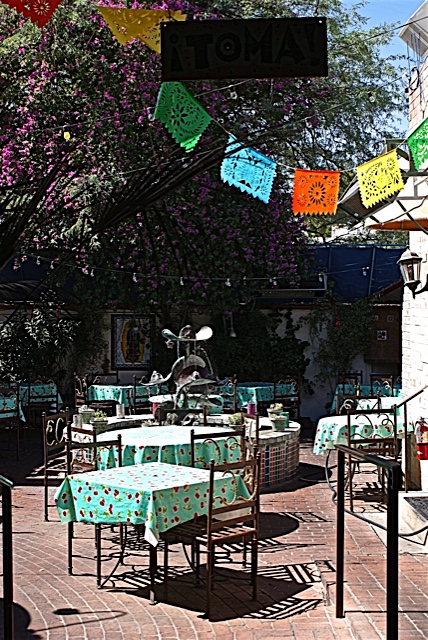

If it's a fine spring or fall day when I visit, I might sit on the patio of Toma, the Mexican-style canteen that is next door to the main restaurant.  Toma means "drink" in Spanish and although I've never been to this part of the restaurant in the evenings, I hear it is a very popular place for margaritas and live music!


If I sit on this patio, I can even see the mesh cage where the beef is dried for the restaurants most famous dish, Carne Seca.

The huge strips of beef are marinated in citrus juice, than dried in the hot Arizona sun then shredded and recooked with chilies, tomatoes and onions.

I can assure you, it is delicious.  In fact, I rarely get anything else when I'm there and I even manage to bring some home with me so I can make some carne seca tacos at home.


The food is incredibly good and the atmosphere is as historic as it is welcoming.  It is a place not to be missed whether staying in Tucson or just passing through.

Just writing this post has made me crave some carne seca.  I'll have to schedule a trip to Tucson sometime very soon.

Sunday, July 24, 2016

Chicago's Most Famous Lions


Standing in "an attitude of defiance" are the two wonderful lion sculptures by artist Edward Kemeys.  They were a gift to the Chicago Art Institute from Mrs. Henry Field for the opening of the building in 1893.  I have a strong memory of a family trip to Chicago when I was just a little kid, seeing those lions as I passed by and knowing at that moment that I would find my way back to this building one day.  And, I did!


I have visited this powerful art museum on numerous occasions and when I had an opportunity to work in Chicago for a little over two years, I became a museum member.  But, I never stopped loving those lions.  I always made a point of entering the museum through this main entrance so that I could admire them on my way in.


The artist didn't give the two lions a name but he designated them by their poses calling the north lion "on the prowl" and the south lion "stands in attitude of defiance".


At Christmas they get decorated with huge holiday wreaths around their necks and when local sports teams are involved in playoffs or tournaments, they might end up with helmets on their heads or some other sporting accessory.

I always look forward to my next visit to the Chicago Art Institute and my encounter with these wonderful lions.

Sunday, July 17, 2016

Let's All Get Some Ice Cream


When doing my research for my last trip to Paris, I stumbled on to an article about an ice cream shop that was worth seeking out because of the quality of the product and the variety of flavors.  The place is called Berthillon and it's located on the I'le Saint-Louis in Paris, one of my favorite places to walk, window shop and people watch.  The directions were perfect, I headed across the bridge and immediately spotted the place ahead of me.


I was warned that the shop is always busy and I'd probably have to wait in line to get my ice cream but, the line moved fast and it was well worth the short wait.  The place specializes in ice cream and sorbets and the flavors are amazing.  Unique combinations like pear and caramel or apricot and raspberry.  My favorite was the chocolate and orange combination.  I enjoyed it so much I went back two more times while I was in Paris.

Sunday, July 10, 2016

An Esthetic Look at Las Vegas


Las Vegas is probably pretty high on the top tourist places in the United States.  It is a mecca for conventions with literally every large hotel having an abundance of convention spaces available for use and an equally abundant supply of entertainment of every kind.  However, it isn't a place that I visit often in spite of being less than an hour's flight from here in Phoenix.  The last time I was there was for a conference and I was lucky enough to have some time to do a little exploring.  So rather than play a few games of chance, I wandered in the direction of the new City Center area of Las Vegas.


I started at the Cosmopolitan Hotel where I admired the Chandelier Bar.  It was early in the day so the bar wasn't open for business but I had a great time wandering around all the strings of chrystel draped elegantly around the lounge area.


From the Cosmopolitan I took the City Center light rail to the end of the line.  When I exited the train I was immediately struck by all the lines that were formed by railings, flooring, and the window of the surrounding high-rise buildings.  What a dizzying sight it was!


I stopped in to the City Center Mall, a spectacular shopping attraction full of sculptures and twinkling lights.  Again, it was early on Sunday morning so I was there before it was flooded with shoppers eager to spend their winnings on some expensive, designer accessories.


I happened to be there when there was a display of some pretty snazzy cars along the mall's walkway.  


Near by were the two whacky residential skyscrapers of the Veer Towers.    My photos don't show it that well but the towers look as though they are leaning.  They aren't of course, they have just been constructed to look that way.


Across the street was the waterfall wall at the front of the Aria Hotel.  It really is a bit mesmerizing watching the water as it glides straight down the dark stone wall.


Another highlight of the area was the Gallery Row Shops.  I spent some time visiting several galleries full of fabulous artworks of every genre.


The galleries included a Chihuly Gallery of fabulous glass works.  I spent some time inside enjoying the beauty of everything inside.


Then it was time to head back the conference so I found my way back to the light rail station and waited for the approaching train.  In the background you can see a little slice of those two leaning towers and you can get a better idea of how they really do look like they are tilted.
Sunday, July 3, 2016

Medieval Europe in New York


Many years ago, I met some Chicago friends in New York for a three-day weekend get-away.  We had the normal New York City plans, a couple of Broadway play, a few museums and lots of fine dining.  One thing we did on the spur of the moment was take a trip out to The Cloisters, the wing of the Metropolitan Museum of Arts that specializes in the art and architecture of Medieval Europe.


The Cloisters is located north of Manhattan in Fort Tryon Park and sits overlooking the Hudson River.  Getting to location is a bit of a challenge for most tourists so the place isn't visited as much as the Met is on a daily basis.  If you take public transportation, it involves subways, buses and lots of walking.  We opted to take a taxi since there were four of us to split the cost.  That worked very well on the trip out but we did have to wait quite awhile to get a taxi back into Manhattan.


Even with all the transportation obstacles, the trip was well worth it.  The place is quiet, peaceful and stunningly beautiful.  The building was designed by Charles Collens and it is an amalgamation of parts of five cloistered abbeys in Europe.  The parts were dismantled stone by stone and shipped to New York where they were reconstructed to form one cohesive building.


The rooms are full of paintings, sculptures and tapestries most of which were once the collection of American sculptor, art dealer and collector George Grey Barnard.

Barnard's works were acquired by John D Rockefeller, Jr. in 1925.  He also purchased the land that is now Fort Tryon Park and commissioned the construction of the building and the landscaping of the site.

It is now part of the Metropolitan Museum of Art.


To me, the true beauty of the place is in it's architecture and landscape as well as the peacefulness of the surroundings.  There is a very special meditative quality to the surroundings that makes you feel like you are having a rare visit to a real cloistered abbey for the day.


I'd very much love to visit here again.  The place is a photographer's paradise and since the last time I visited was before digital photography, these scanned photos do not do it justice.  Maybe I'll visit again the next time I find myself in New York.  I bet the hotel could arrange a driver for the trip there and back.

Sunday, June 26, 2016

Italian Mountain Retreat

Last week I posted about a day spent driving around the mountains of northern Italy.  I thought I'd follow up that story with one place I stopped and spent a little more time exploring.  That place is the town of Cortina located in a beautiful valley and surrounded by mountains full of hiking and ski trails.  The town is well known in Europe as a winter sports area.  In fact, the population of Cortina grows from its normal 7,000 to around 40,000 during the winter months.  The town even hosted the winter Olympics back in 1956.


As we rounded a bend in the road and the view of the city opened up, the sight almost took my breath away.  It sits in a spectacular setting with the jagged edges of the Southern Alps rising above it and surrounding it in a picturesque embrace.


During the spring and summer months, the town is much quieter and one can walk the streets and admire the scenery and window shop without the jostling of crowds.  It's hard to imagine these narrow streets occupied by 40,000 people all in bulky ski clothes.


The town center is dominated by the tall bell tower of the Basilica Minore dei Santi Filippo e Giacomo.


The church is a Roman Catholic parish built between 1769 and 1775. 


Apparently the town is very Popular with "society types" and is especially known for its apres-ski social scene.  There are lots of parties and many clubs active during the long winters.  


Since I was there in warmer May, I missed out on any celebrity sightings but, I didn't miss out on the beautiful mountain splendor and the warmth of the people in the shops and on the street.  

Sunday, June 19, 2016

A Drive in the Mountains


No matter where it is, a drive in the mountains is always inspirational.  The tall trees and the green hills are a perfect backdrop to some adventurous explorations.  When I visited Italy a few years ago, I spent one day doing exactly that, exploring the Dolomites of northern Italy.  Driving along the road I passed beautiful villages pressed against the mountains as though they were hugging the land in appreciation.


Some villages clambered up the side of a hill and then capped the effort with a tall tower above it all.


In other places a castle could be spotted sitting in a high enough position to watch everything that passes by its doors.


Some villages brought images of ski slopes and resorts to mind with their Alpine chalets and an occasional chair-lift.


Tiny churches clutched the edge of the road with their steeples appearing to mimic the rocky peaks behind them.


Every now and then a group of brown cows would gather at the side of the road with curious stares to go along with the clanging of their cow-bells.


Some settlements sit so precariously on the side of a mountain that I wondered how they keep from sliding down especially when the snows come.


Rounding the curves in the road always brought some new vista to admire.  Sometimes it's a green valley, sometimes the steep slope of the mountain and sometimes a picturesque village that requires a quick stop to admire and photograph the scene.


Above it all are the jagged, snow-covered peaks framed by the soft green of the pine trees swaying in the mountain breeze.  The magnitude of these grand mountains are both awe inspiring and humbling to me and following the winding roads through them was an adventure I will never forget.

Sunday, June 12, 2016

Arriving in Rome


I am very good with maps.  Once I have my sense of direction, the map will help me to identify where I am and where to turn next.  But, first I have to get my sense of direction.  That is why when I arrive in a new city that I've never been to before, I first ask for someone at my hotel to point me in the right direction using my map as the guide and then I set out for a walk to make sure I've got my bearings.  That is exactly what I did when I arrived in Rome Italy for the very first time.


After a hair-raising ride in a taxi from the airport and settling into my hotel room, using my map, I asked the man at the front desk to point me in the right direction and off I went.  That first walk around a new city it always a bit of an adventure.

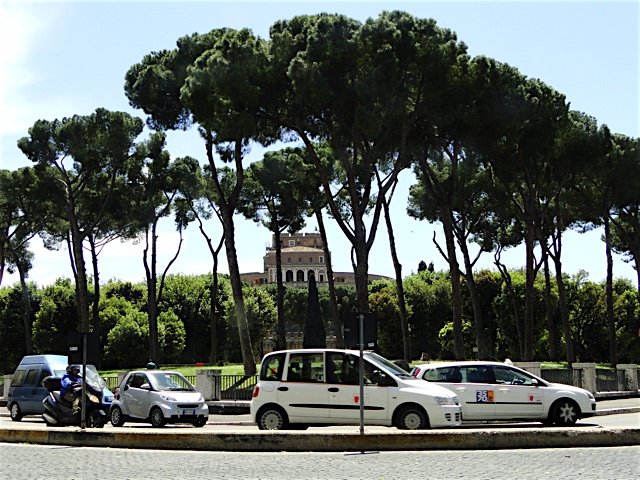
I found myself in awe of the tall umbrella pine trees that lined the streets and set the tone for my explorations.

I came to a monument that was not identified on my map but, the name on the plinth was Camillo Benso di Cavour, a statesmen who was instrumental in the unification of Italy.


A little further along I came to this rather grand building and my map called it the Palace of Justice.  It houses the Supreme Court of Cassation, the highest court of appeal in the country.


I learned that it was built in 1888 and is completely covered in travertine limestone.  I also learned that it's popular name among locals is "Palazzaccio" or "the bad palace".  I guess the idea is you don't wan't to end up here.


The building is topped with a quadriga sculpted by Ettore Ximenez of Palermo.  What is a "quadriga" you ask?  It's a word that describes a statue consisting of a chariot pulled by four horses.  I've seen many such statues before but had never seen that word before seeing it in my guide book.


Before long I had made my way to the Tiber River and a stroll along the river under the shade of the trees was a special treat for this first time visitor.


I passed simple bridges and bridges adorned with statues.  And when I crossed the bridge I found more places to explore and more statues and monuments to admire.


I found another bridge to cross back, confident that I had a good idea of how to follow my map and arrive at the places I wanted to see.  It was time to head back to the hotel and freshen up for a long evening walk and my very first Italian dinner! I'll post more about walking and eating in Rome another time.