Sunday, June 11, 2017

A Lesser Known Tuscan Village


After spending four days in some of the most famous Tuscon cities like Florence, Siena, San Gimignano and Cortona, my travel companions and I headed eastward on a swift moving super highway.  Off in the distance I spotted a hilltop village that rivaled the look of those other more famous villages that we had just come from.  A sign on the highway proclaimed the name of the village as Sinalunga and my friends and I made a quick decision to take a detour to check out this picturesque city at the top of a hill.


As we reached the top of the hill, we found a place to park the car near where the looming facade of Collegiate di San Marino anchored an open public square.  The church was appealing with it's yellow front and brick bell tower.


The narrow streets reminded me of Siena but, they were a lot less busy.  In fact, on our entire walk through the village we only passed one other person.


We found the city full of narrow passages and little open gaps with views out over the Tuscan countryside between the buildings.


Like Siena, Sinalunga is an Etruscan settlement but unlike the more famous town, little is known about it's past.


I loved all the arched doorways and the way the bricks peeked out from the crumbling stucco in the most charming way.


It was late in the afternoon and the lowering sun cast a golden-hour glow over some of the westward facing buildings.  It lit up this balcony with its summer-like warmth.


Visiting the popular villages in Tuscany has its rewards but, finding the equally beautiful places off the beaten path gives the "explorer" in me a much relished sense of accomplishment.

Sunday, June 4, 2017

A Glimpse Into London's Past


Like most visitors to London I always seemed to confine myself to the major museums and attractions on each visit however, on this last trip I decided I should visit some museums I had never been to before.  The Museum of London is one of those places.


The Museum of London documents the history of London from prehistoric times to present day.  It's located in the City of London, very close to the London Wall, that relic of Roman occupation dating back to the second century.  The museum itself is very 20th Century in design.  It was opened in 1976 as part of the Barbican Center, a cultural complex that many Londoner's love to hate.  The museum's pathways direct the visitor from prehistoric times to modern day.

Just outside the entrance to the museum stands a large sculpture by Christopher Le Brun called "Union, a Horse with Two Discs".


There are many Roman era artifacts on display showing just how influential and developed the Romans were when they settled in this area.


In one dimly lit room, there is an elaborate display of a Georgian Pleasure Garden.  It was full of mannequins dressed in colorful costumes depicting the people and entertainment that might be found in such gardens.

The Pleasure Gardens were magical places where city dwellers could escape from the dirt and grime and unpleasant smells of the city to a place where refreshments could be enjoyed while being entertained by exotic street performers.  It was a little escape from every day life.


A little further on I caught sight of a collection of jewelry worn by the peerage and aristocracy.  The Orders of Chivalry "jewels" were worn as a sure sign of status and recognition.


A few weeks ago I posted about Selfridges department store and it's colorful history.  The Museum of London is home to a beautiful art deco "lift" that was installed in the store in 1928 just in time for the store's 20th anniversary celebration.  Young women wearing distinctive uniforms were employed to operate the lifts taking shoppers from floor to floor.


The Lord Mayor's ceremonial coach was on display in one room.  This coach is used annually at the Lord Mayor's Show.  I got to see that show back in 2013 on a previous visit to London and indeed, this coach with the Lord Mayor in it was the center piece of the parade.


Because the coach is used today it is deemed the oldest ceremonial vehicle in regular use in the world.

Another room in the museum housed a display that was closer to the present day.  It was display of the 2012 Olympic cauldron designed by Thomas Heatherwick.

Every single copper cauldron piece is different.  Each was shaped by hand and some took days to make.


The display showed it standing tall and.....


.....fully opened.  The design of the cauldron is described as one of the best kept secrets of the opening ceremony.  Along with the cauldron, there were several video's playing so I could see it as it looked in it's glory days.


I found these dapper gentlemen wandering around the museum gift shop.  They are members of the Pearly Kings and Queens, an organization dating back to 1875.  It is a charitable organization of working class culture in London.

Don't these gentlemen look magical in their pearl button laden suits?


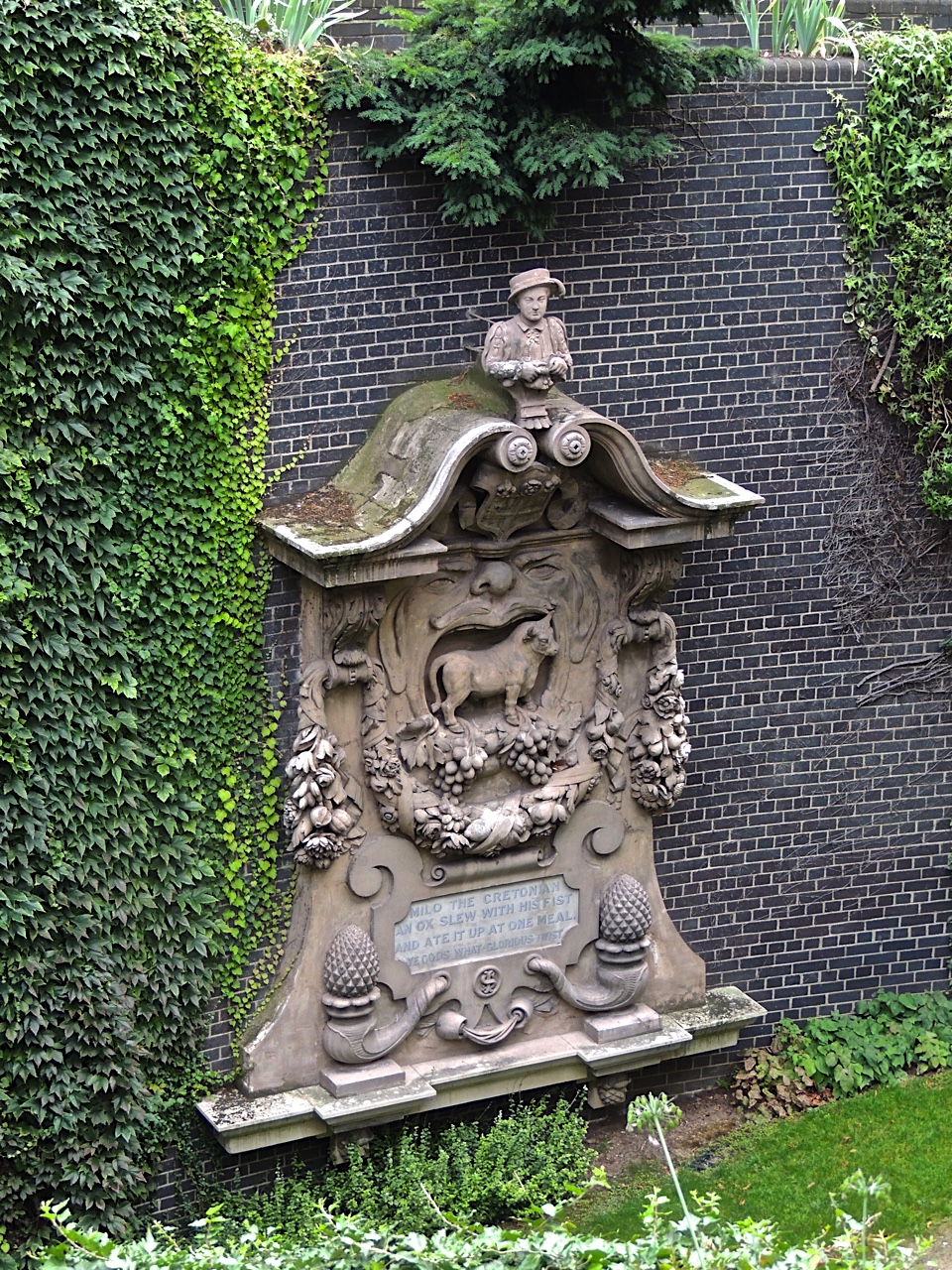
As I was leaving the museum I saw this rather interesting sculpted plaque located in a sort of garden courtyard.  I couldn't quite figure out what it was supposed to be depicting so I had to do a little research about it.
I learned that it supposedly commemorates the Bull and Mouth Inn which was demolished in 1830 to make way for the Queen's Hotel which in turn was demolished in 1888.  The face eating the bull is said to represent Milo of Croton, a Greek wrestler who rumor says carried a bull on his shoulders.

That is one piece of historic art that has a meaning which remains deeply buried in the folds of time.

Sunday, May 28, 2017

The Narrow Streets of Siena


My hotel in Siena was just outside the walled center of the city so my very first glimpse of Siena although beautiful and oozing with Tuscan charm, gave no hint of what I was going find beyond the gates into the ancient part of the city.


The streets were narrow and yet used by both pedestrians and vehicles.  Fortunately, drivers were careful as they rounded corners and eased their way through the streets.


Every turn on to another street revealed more buildings that have housed families for centuries and are still homes and businesses.


Beautifully adorned grocery stores tempted me with perfect looking fruits and vegetables not to mention the pasta of every shape and size.  If I'd had a kitchen available to me I would have certainly picked up the fresh ingredients for a lovely Tuscan dinner.


Siena has been declared a UNESCO world heritage site and all you have to do is walk these narrow streets to see why.  It was the first place settled by the Etruscans between 900 and 400 BC.  Imagine that!  At one time in its history, it was home to 50,000 people.


I found my self wondering what it must have been like to live in the city at that time and every now and then I would run across a person in period clothing adding flavor to my growing imagination.


Siena is the kind of place where it's easy to feel what it must have been like to live in a city more than a thousand years ago.  I'm sure we twenty-first century humans would find it impossible but to those living there at that time it was the normal way of life.

Siena is a magical place that I'd love to explore again one day.

Sunday, May 21, 2017

Banking on Lunch in the City


After a busy morning walking the wonderful streets of London, my legs told me it was time to sit and relax for a while.  So while wandering along among all those tall and exotic looking buildings in the City of London, I was keeping my eye out for a good place to have lunch and take a break from all that walking.

When I peeked in the open door of The Counting House I knew I had found the perfect spot.

How can a pub be so gorgeous?


I soon learned that what was now a pub was once a bank dating back to 1893.  It was once the home of Prescott's Bank to be exact.  And, the history of the place doesn't stop there.  The original bank building was built on the site of an old Roman basilica with the foundations of this building resting on ancient Roman walls.


I ordered a delicious pasta dish from a very friendly waitress who was happy to fill me in on some of the history of the place.


The bar of the pub sits in the center of the room and was once the place where banking transactions took place.  The domed glass ceiling and the chandeliers all date back from it's financial past.  I especially liked the supports that held up the antique brass foot rail around the bar.


The Counting House proved to be a great place for lunch with a splendid history and some very beautiful furnishings.  Squeezed in between all those glass and steel towers that the City of London is famous for, it was a gem of old world charm.

Sunday, May 14, 2017

The Real Old West


People who visit Arizona with a craving for some old west atmosphere tend to end up in places like Tombstone  to savor what the wild west must have been like.  However, there are lots of other towns in Arizona that have held on to the flavors of the west without all the tourist traffic.  Florence Arizona is one of those places.

The town of Florence has over 25 buildings listed on the National Historic Register and one of them is the beautiful Pinal County Courthouse.  Built in 1891, this three-story red brick building sits proudly in the heart of the city.  The architectural style is Late Victorian Revival that is topped like a wedding cake with an ornate clock tower.  The only problem is that when it was built, the city ran out of funds and  couldn't afford a working clock so the clock is painted on with the hands permanently showing the time at 11:44.  If you think of that positively, it's right on the money twice a day.

The courthouse has since been replaced by a modern facility on the edge of town but, this building is being restored to serve as government offices.


Main Street in Florence is a treat to explore with many old buildings constructed of adobe bricks still in use today.


The sidewalks are reminiscent of days long passed.


One might pass an antique store or an old saloon that still thrives to this day.  These buildings are all adobe walled and built in what was called Sonoran Style.  Some of them still have the viga and saguaro rib ceilings.


One place is the headquarters for the Rynning's Rangers, an all volunteer force that provides community service in the form of assistance to law enforcement and to keep alive history, tradition and heritage of the Arizona Territorial Rangers and the old west.


The local newspapers, the Florence Reminder and the Blade Tribune are located in this well-maintained historic house.


Most of the other homes in the central part of town are all constructed from adobe brick with a stucco covering and adorned with beautiful old doors and windows. 

Have you ever heard of a the silent film star named Tom Mix?  He was the handsome star of some 291 movies between 1909 and 1935.  In October of 1940, he was driving from Tucson to Phoenix in a 1937 Cord 812 Phaeton and was probably traveling well over the speed limit (if there was a speed limit at that time) when he lost control of the car and it overturned into a wash. He was killed in the accident that was located on a spot about 18 miles south of Florence.  Since then, a memorial to him has been located on the spot and a little roadside rest stop surrounds it. The inscription reads "In memory of Tom Mix, whose spirit left his body on this spot and whose characterizations and portrayals in life served to better fix memories of the old West in the minds of living men."
You won't see any theatrical gun fights or any stage coaches taking visitors for rides but, you will see a little slice of history and you can get a true sense of an old west town by visiting Florence Arizona.

Sunday, May 7, 2017

Mass Transportation, London Style


Moving people back and forth is the hallmark of any great city and no one does it better than London.  I think pretty much everyone in the world can equate the city of London with those double-decker buses and the infamous "tube".

On my last trip to London, I thought it was about time I learned a little more about how the city developed such a sophisticated and efficient transportation system.  So, I headed to the London Transport Museum in Covent Garden.

The museum explores how London transportation models have evolved over the past 200 years and emphasizes the link between efficient transport and the growth of a modern and thriving city.


The museum got its start back in 1920 when the London General Omnibus Company decided to preserve two Victorian horse buses and an early motorbus for future generations to see.


The museum itself has been located in several places around the city over the years before it found a perfect spot in the center of Covent Garden, one of the busiest places in London.


The collection is arranged in a sort of timeline from the very beginning of public transport with horse drawn wagons and busses to rail systems to motorized busses and then on to the oldest underground network of trains in the world.


There is even a display explaining how those iconic "underground" signs were designed and how their design has evolved over the years.


Another display tells about the fabrics used to cover the seats on the train cars and how the different train lines have different patterns in their upholstery fabrics.  The gift shop even had tote bags and eye glass cases made from the same fabric so you can pick up a little piece of the London Underground and take it home with you.


The buses on display and the underground train cars were all open for exploration.  I spied a lot of children checking out the driver and engineer compartments to see if they could drive one of those busses or trains.


One of my favorite things in the museum was this map that showed where the different underground train lines were actually located so deep under the busy city above them.  A white line would show up outlining the route of the different lines as they were identified above the map.

It is a very interesting museum and is especially appealing to youngsters.  So, if you are a family traveling to London, it's a great place for kids to get a hands-on experience.