Photography and travel are my two passions. This blog will feature photos from my travels and little anecdotes about my experiences and discoveries.
Sunday, October 30, 2016
Home of a Victorian Artist
I'm not sure how I heard of Leighton House but it was on my list of places to visit while I was in London so on one of the gloriously sunny days I recently spent in the city, I made my way to Holland Park to visit the home of Frederic, Lord Leighton.
Leighton's home bears the famous blue plaque, a historic designation and is operated as a museum.
Photography was not allowed inside the house, a point that was made very clear to me probably because I had a camera hanging front and center around my neck.
However, not being one to follow all the rules, I did manage to snap two shots inside the house using my cell phone in a stealthy sort of way. (After all, there are dozens of photos on the internet, just Google Leighton House and look at the images.) This room on the ground floor is called the Arab Hall and is covered with beautiful Arabic and Islamic tiles.
The home was designed by architect George Aitchison guided by Leighton's precise specifications. It was built to be an artist's home with a studio at the back of the house, facing north with floor to ceiling windows to allow in as much light for the painter to work with natural light flooding the room. I wish I could have gotten a photo of that room, it was beautiful but carefully patrolled by museum guides.
The second photo I took was from the stairway looking down into the Arab Hall and the entrance foyer in front of it.
If you haven't heard of Leighton the artist you might want to check this link to see his most famous painting called "Flaming June". I've never seen that painting in person but, I've seen many a photo of it, especially in art gallery gift shops.
The painting belongs to the Museo de Arte de Ponce in Puerto Rico.
While I was at Leighton House, I heard one of the guides mention the the painting was on it's way to London for a temporary exhibit at Leighton House from November 2nd 2016 to April 2nd 2017. So, if you are a reader who will be in London during that time, I would recommend you go see it. You will get to see the artist's fabulous home and his most famous painting all in one visit. Here is a link to an article about the painting and it's upcoming visit to London. The article tells quite a story surrounding that famous painting.
Sunday, October 23, 2016
That Little Belgian Detective
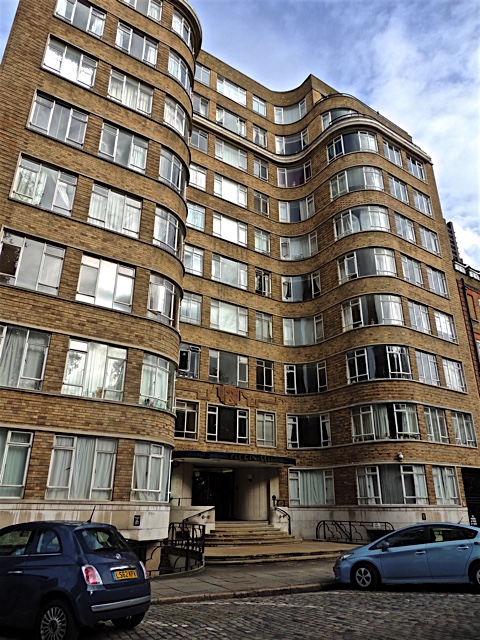
If you happen to be a fan of the detective series that aired on television between 1989 and 2013 called Agatha Christie's Poirot, you will be familiar with this building. This is the building that was used for all the exterior shots of where Hercule Poirot lived in London. Being a huge fan of the art deco era in building and design, the look of this building always appealed to me. I also thoroughly enjoyed David Suchet's portrayal of the eccentric detective with the waxed mustache and those busy "little grey cells."
When I went to London back in 2013, locating and photographing this building was on my list of things to do. However, when I got there I was dismayed to find the front of the building covered in scaffolding because of renovations. Oh well, I snapped the above photo anyway.
So on this most recent trip to London I decided to try again and I was happy to find the front of the building clear of all construction and I was able to snap a few photos.
However, I couldn't get the exact shot I wanted. This time when I got there, the little park in front of the building was all torn up and completely fenced in making it impossible to take a photos directly in front of the building.
Oh well, such is my luck. The top photo and this one and the one above will have to do.
I did manage to walk up to the front and snap this photo through the door. I was very pleased to see that the lobby of the building has maintained that 1930's art deco style that I recall seeing portrayed in the television series. Everything looks so incredibly vintage with the exception of that security monitor in the upper right corner. I'll just pretend it isn't there.
Sunday, October 16, 2016
King, Queen, Bishop, Knight
Of all the towering statues and Egyptian sarcophagi, I found myself most intrigued by this small little treasure when I recently visited the British Museum. The Lewis Chessmen are a group of 12th century chess pieces that were discovered in 1831 on the isle of Lewis in the Outer Hebrides in Scotland. They make up the most complete surviving medieval chess sets in the world.
The museum thinks the chessmen were probably made in Trondheim Norway sometime in the 1100's. They are carved mostly of walrus ivory with a few pieces made from whale teeth.
I'm not a chess player so I'm not quite sure why these little chessmen drew so much of my attention. It probably has more to do with the age of the set and the details in the carvings and the fact that a game that is popular today has it's roots so deeply imbedded in history.
The chessmen in the set reflected the order of feudal society and the game was devised to sharpen the tactical skills of knights. It became one of seven knightly accomplishments.
One of the information cards at the museum said that this set is one of the most popular and well traveled of it's exhibits. Pieces from the set have traveled all over the world for different exhibitions. I had it all to myself for quite a while.
Sunday, October 9, 2016
Granite Dells
Two years ago, my sister Judy and I took a drive out to Watson Lake located in an area called the Granite Dells. It's a beautiful spot full of amazing rock formations and a wonderfully refreshing lake. The lake was formed after a dam was built on Granite Creek. Since that time, the city of Prescott Arizona bought the land in order to preserve it as a recreational spot.
Visitors can rent a canoe and enjoy a day paddling around the lake or they can use the rocks to practice their rock climbing skills.
Judy and I just like to take our cameras and capture the unique beauty of the place.
Sunday, October 2, 2016
Ancient Arena
The ancient arena in Verona Italy is certainly a tribute to the architects who built it because this one is still in use today. Built in the first century, it has proved itself to stand the test of time.
As you can see from the sign above, there is a schedule of operas that were being performed here back in 2012 when I last visited. In fact, the arena is known for its grand scale opera productions but, word has it that a few rock concerts have also used the venue from time to time.
Oh look, I think I see some actors headed that way right now!
Sunday, September 25, 2016
The Oxford Version
Popularly called "The Bridge of Sighs", this bridge in Oxford England is actually the Hertford Bridge linking two sections of Hertford College. It got it's nickname from the Bridge of Sighs in Venice but, it actually looks more like the Rialto Bridge in that city than the real Bridge of Sighs.
I'm actually in England right at the moment so I'm hoping to get some new photos of some of my favorite places like this spot.
Sunday, September 18, 2016
Church with the Longest Name
If it hadn't been for Mo of Fresh Eyes on London, I never would have found this wonderful old church.
The Priory Church of St. Bartholomew the Great (how's that for a long name) was established on this site in 1123. For us Americans, that is a very, very, very long time ago.
Locals tend to call the place Great St. Bart's and given that long name it's clear why.
Stepping inside this church is truly a huge leap back in time. This is a historic church that clearly shows it's age.
Parts of the church were destroyed in the fourteenth century but other areas have survived even managing to avoid the fates of the great fire of London in 1666. However, the church did fall in to disrepair for a while.
The Founder's Tomb.
While walking around this ancient church, Mo and I discovered this talented fellow working on a charcoal drawing. I think this photograph is my favorite of all the photos I took on this visit to London.
This church is truly a hidden gem in the London.
Sunday, September 11, 2016
Mystery Castle
Today's sojourn wasn't very far at all because this unusual place is located right here in my home town of Phoenix Arizona. I'm talking about Mystery Castle, a place located at the base of south mountain that many Phoenicians don't even know about.
Back in the 1930's, Boyce Luther Gulley of Seattle Washington learned that he had tuberculosis, a diagnosis that changed his life forever. Rather than whither away in front of his friends and loved ones, he decided to head to a more arid climate and ended up in Phoenix Arizona. It was here that he started to build a castle for his daughter Mary Lou. As the story goes, neither Gulley's wife nor his daughter knew where he was so they had no idea that this endeavor was under way in the desert southwest.
Gulley constructed his castle from found objects and inexpensive materials. The whole thing is held together with cement, mortar, calcium and goats milk. It's constructed of stone, adobe, old auto parts and rail tracks and telephone poles.
The building is two stories high with several patios and outdoor spaces.
All sorts of odd things can be seen embedded in the walls along with colorful, hand-painted tiles.
Gulley died in 1945 and Mary Lou and her mother were notified that they had inherited property in Phoenix Arizona. This was a surprise to them but, they packed up and moved to the their new home.
A writer from Life magazine heard about the castle and wrote a story for the magazine about it and the mystery that surrounded it. That story brought attention to the place and Mary Lou and her mother soon started giving tours of the place in order to make some money. Mary Lou continued the tours even after her mother passed away.
In fact, Mary Lou conducted tours of the place right up to her death in 2010. The property is now owned and operated by the Mystery Castle Foundation and tours continue to be given but only in the winter months.
To the left is a portrait of Boyce Luther Gulley that is located inside the castle.
Sunday, September 4, 2016
The Church of St. Peter
My visit to St. Peter's Basilica was a monumental event in my life after hearing so much about it over the years. It did not disappoint. From the time I was a child in grade school I heard the stories of its role in history and I saw the historic photos.
One only has to step through the doors to grasp it's sheer size. Walking from front to back is much like walking the full length of a very large mall....twice. Being on a private tour that I arranged in advance allowed my friend and I to skip the long lines and walk right in.
There is so much to see that it can be a bit overwhelming. While listening to the guide, I found my eyes wandering from statue to statue to every tiny detail of the walls and arches.
The high altar is a spectacular sight with all of it's gold trimmings and papal decorations.
I found myself wondering how such an amazing place has existed since 1626.
I also thought about St. Peter's tomb far below my feet.
My lens found its way to this beautiful statue of St. Therese by Filippo Della Valle. Her face was so full of emotion as she appears to have been interrupted from her writings.
Of course, the most popular statue in the basilica is Michelangelo's Pieta which now is viewed behind bulletproof glass after a vicious attack with a hammer back in 1972. How anyone could want to destroy such a beautiful piece of art is beyond my ability to understand.
Back on the outside, I took some time to admire Bernini's Colonnade that encircles the basilica.
And this seagull and I both admired Malerno's fountain at the center of the piazza.
Visiting this historic place is an experience I won't forget.
Sunday, August 28, 2016
Pyramids of Canada
In Edmonton Alberta, the Muttart Conservatory adds a unique shape to the city's skyline. Four glass pyramids house plants from around the world. Three of the pyramids feature permanent displays representing the three distinct biomes of temperate, arid and tropical. The fourth pyramid offers changing exhibits and programs. A visit to this place is well worth the effort if you find yourself in the lovely city of Edmonton.
Sunday, August 21, 2016
Before the Latest Flood
About 16 years ago I visited a friend I had worked with in St. Louis at her home in Ellicott City Maryland. While I was there I took this picture of the very quaint city center and I noticed how the city sat in beautiful rolling hills. A few weeks ago I heard a news story that Ellicott City had been hit with a devastating flood. It's hard for me to think of such a beautiful and historic place being ravaged by flood waters. When I saw this photo in my files, it reminded me of what a pretty place this was all those years ago.
Sunday, August 14, 2016
A Garden Legacy
The billionaire mining tycoon who was born in Montana, schooled in the east and in love with the west left a beautiful and enduring legacy in the state of Arizona in the form of the Boyce Thompson Arboretum.
The arboretum is full of a multitude of trails that all offer something beautiful and educational. There are high trails with spectacular mountain views and low trails with shady areas that make you forget you are in the desert.
William Boyce Thompson was not a great student in grade school in Montana but he matured after going to school in the east and studying engineering. He became enamored with the mining industry and began building a career in the industry and in mining investments. He made his first million in 1906 after investing in mining in Nevada, Arizona and Utah. In 1907 he purchased the Magma Mine in Superior Arizona and that is where he began his love affair with the high desert area surrounding the mine. He built a large home overlooking a canyon and made several land swap deals to obtain the property around the home.
In 1909 at the age of 40 he began his philanthropic endeavors with numerous endowments, scholarships and fellowships. He hired Franklin J Crider from the University of Arizona to establish the Boyce Thompson Southwest Arboretum. It survives to this day as an Arizona State Park that continues his educational and preservation directives.
There is a huge greenhouse located on the property where plants from arid climates all over the world are cultivated and grown.
A favorite trail among visitors is the Australian walk-about trail complete with an old and rustic cabin and....
...Australian native artworks.
There are quiet places to sit and read among the wildflowers.
One of my favorite places at the arboretum is the Demonstration Garden where there are several gardens set up in different styles and all suited for arid climates. The one above was especially beautiful.
I can sit in that area and enjoy the birds and bees and dragonflies all around.
Boyce Thompson Arboretum is located about an hours drive from Phoenix just outside of the mining town of Superior Arizona on the US 60 highway.
Subscribe to:
Posts (Atom)