Sunday, July 2, 2017

Crystal Cove


For the past 10 years, I've been fortunate enough to spend a few days in southern California during the month of August to cool off a bit from the extreme summer heat of Arizona.  One of the places that I manage to visit every year is Crystal Cove State Park.


There is a lot more to Crystal Cove State Park than beaches and trails, this special place has preserved a bit of California beach-life history that can't be found any longer along the California coast.


You see, way back in 1864 a man named James Irvine acquired a very large swath of what we would call today "prime" property.  His son James Irvine II turned that land into an agricultural empire known as the Irvine Company.


The beaches on the Irvine property became a favorite spot for Irvine II and he allowed his friends, family and some employees to build cottages on the site forming a community called Crystal Cove.

Over the years, the cottages were renovated and slowly it became permanent homes to a number of people who began leasing the land from the Irvine Company around 1940.  The settlement became a favorite spot for artists, actors and writers.  In 1979, the Irvine Company sold the property to California State Parks and that sale started a 26 year legal battle with residents who wanted to stay on the property.  In the end, the state won the battle but, rather than tear down all the cottages, they agreed to preserve and restore them so they could be enjoyed by everyone visiting the park.  


Today when you visit, you will find a museum that displays one of the 1920's to 1940's era cottages giving visitors a peek into that long gone beach lifestyle.  There are a total of 46 cottages, 21 of which have been renovated are now available for vacation rental.  


The most famous of the cottages on the site is the "Beaches" cottage which was used in the Bette Midler film by the same name.


One of the cottages has been turned into The Beachcomber, a great restaurant that sits about as close to the crashing waves as a restaurant can get.  Over the years, I've enjoyed breakfast, lunch and dinner  there and have always enjoyed every meal.


Of course the beach is what draws many people to the site but, I have to admit that the wistful feeling I get when I walk along the beach and look at all those ramshackle cottages is what draws me back time after time.


One year I even stumbled on to a photo shoot with an attractive model all decked out in 1940's clothes and hair style.  The background of those old cottages must have been perfect for these shots.


I suspect that I'll be back again for another visit come this August.  After all, I can soak up some California history, enjoy the flora and fauna and savor another delicious meal.  And then there's the BEACH!  There is always the BEACH!


Sunday, June 25, 2017

Adventures in the Andes


Last week I told you a little about a tour into the Andes Mountains in Argentina that took us almost to the border with Chile.  This week I'll show you some of the other things we stopped to see on that drive.  We had hired a driver and guide to take us from our base in Mendoza into the mountains.  The above photo is of Puente del Inca (The Inca Bridge), a natural arch that has formed over the Vacas River.  It was formed by hot springs rich in sulfuric waters that have caused that sort of rust-like sediment.


At one time there was a spa and resort located here that was used for curing illnesses.  The remains of parts of the spa can be seen sort of fused into the mountain by the sediment and water from the spring.


Off in the distance I spotted this little church that looks like it might be still active today.


While we were stopped to see the natural bridge, I saw this mountain guide with his pack mules headed out.  I wondered if he was joining a climbing team who were going to attempt their own somewhat riskier Andes adventure.


Another stop we made was at the Andinistas Cemetery sometimes called the Climbers Cemetery.  


It is the final resting place for many mountain climbers, some who died trying to reach the top of Aconcagua, the tallest peak in both the southern and western hemisphere.  Other graves here were climbers who just wanted their final resting place to be here in this beautiful and remote location close to the mountain they loved. 


I do have to admit, the views from the cemetery were pretty spectacular.


In every direction we were surrounded by breathtaking vistas.  


The last stop before returning to Mendoza was to see the Uspallata Vaults which date from colonial times.  They are dome-shaped structures that were used at one time for melting gold and silver that was mined in the nearby mountains.  

The trip into the Andes Mountains was an adventure full of historical sightings but most of all sublime beauty in every direction!

Sunday, June 18, 2017

Climbing Up Into the Andes


Aconcagua is the highest mountain in the both the Western and Southern hemispheres and for those die-hard mountain climbers, it's on their must-climb list.


My climb into the Andes was much simpler.  Along with my traveling companions, I made my way up to this view point by a comfortable van driven by a mountain guide.  Not being one of those mountain-climbing obsessed people, I preferred to view the mountain's majesty from a safe distance.  We were already at an altitude of nearly 12,000 feet, I didn't need to check the air at 22,838 feet.


Just past the stop to view Aconcagua, we entered the village of Las Cuevas, the last Argentinian city along Route 7 before entering the country of Chile.  We would have ventured the last few miles into Chile if the border had not been closed at the time.  Apparently there was a labor dispute with the border guards.


Whatever the reason for the closure, it was causing quite a back up of trucks waiting to cross the border with their goods.


Between 1910 and 1984,  the Transandio Railroad operated from here all the way to Las Andes in Chile.  In 1927, the railroad was electrified using Swiss built electronic locomotives.  Today the tracks are starting to crumble and the station is looking a little lost in time.


We stopped in Las Cuevas long enough to get a few snacks and enjoy some hot chocolate.  Our hosts seemed pleased to have the company for the short time we were there.


At 11,748 feet above sea level, you can imagine the extreme weather conditions this remote city experiences.  There are many occasions when the pass through the mountain is blocked by snow.  We were there in November toward the end of spring for the southern hemisphere.

Las Cuevas was a picturesque place with its steep roof lines framed by those grandiose mountains frosted with patches of snow.

Sunday, June 11, 2017

A Lesser Known Tuscan Village


After spending four days in some of the most famous Tuscon cities like Florence, Siena, San Gimignano and Cortona, my travel companions and I headed eastward on a swift moving super highway.  Off in the distance I spotted a hilltop village that rivaled the look of those other more famous villages that we had just come from.  A sign on the highway proclaimed the name of the village as Sinalunga and my friends and I made a quick decision to take a detour to check out this picturesque city at the top of a hill.


As we reached the top of the hill, we found a place to park the car near where the looming facade of Collegiate di San Marino anchored an open public square.  The church was appealing with it's yellow front and brick bell tower.


The narrow streets reminded me of Siena but, they were a lot less busy.  In fact, on our entire walk through the village we only passed one other person.


We found the city full of narrow passages and little open gaps with views out over the Tuscan countryside between the buildings.


Like Siena, Sinalunga is an Etruscan settlement but unlike the more famous town, little is known about it's past.


I loved all the arched doorways and the way the bricks peeked out from the crumbling stucco in the most charming way.


It was late in the afternoon and the lowering sun cast a golden-hour glow over some of the westward facing buildings.  It lit up this balcony with its summer-like warmth.


Visiting the popular villages in Tuscany has its rewards but, finding the equally beautiful places off the beaten path gives the "explorer" in me a much relished sense of accomplishment.

Sunday, June 4, 2017

A Glimpse Into London's Past


Like most visitors to London I always seemed to confine myself to the major museums and attractions on each visit however, on this last trip I decided I should visit some museums I had never been to before.  The Museum of London is one of those places.


The Museum of London documents the history of London from prehistoric times to present day.  It's located in the City of London, very close to the London Wall, that relic of Roman occupation dating back to the second century.  The museum itself is very 20th Century in design.  It was opened in 1976 as part of the Barbican Center, a cultural complex that many Londoner's love to hate.  The museum's pathways direct the visitor from prehistoric times to modern day.

Just outside the entrance to the museum stands a large sculpture by Christopher Le Brun called "Union, a Horse with Two Discs".


There are many Roman era artifacts on display showing just how influential and developed the Romans were when they settled in this area.


In one dimly lit room, there is an elaborate display of a Georgian Pleasure Garden.  It was full of mannequins dressed in colorful costumes depicting the people and entertainment that might be found in such gardens.

The Pleasure Gardens were magical places where city dwellers could escape from the dirt and grime and unpleasant smells of the city to a place where refreshments could be enjoyed while being entertained by exotic street performers.  It was a little escape from every day life.


A little further on I caught sight of a collection of jewelry worn by the peerage and aristocracy.  The Orders of Chivalry "jewels" were worn as a sure sign of status and recognition.


A few weeks ago I posted about Selfridges department store and it's colorful history.  The Museum of London is home to a beautiful art deco "lift" that was installed in the store in 1928 just in time for the store's 20th anniversary celebration.  Young women wearing distinctive uniforms were employed to operate the lifts taking shoppers from floor to floor.


The Lord Mayor's ceremonial coach was on display in one room.  This coach is used annually at the Lord Mayor's Show.  I got to see that show back in 2013 on a previous visit to London and indeed, this coach with the Lord Mayor in it was the center piece of the parade.


Because the coach is used today it is deemed the oldest ceremonial vehicle in regular use in the world.

Another room in the museum housed a display that was closer to the present day.  It was display of the 2012 Olympic cauldron designed by Thomas Heatherwick.

Every single copper cauldron piece is different.  Each was shaped by hand and some took days to make.


The display showed it standing tall and.....


.....fully opened.  The design of the cauldron is described as one of the best kept secrets of the opening ceremony.  Along with the cauldron, there were several video's playing so I could see it as it looked in it's glory days.


I found these dapper gentlemen wandering around the museum gift shop.  They are members of the Pearly Kings and Queens, an organization dating back to 1875.  It is a charitable organization of working class culture in London.

Don't these gentlemen look magical in their pearl button laden suits?


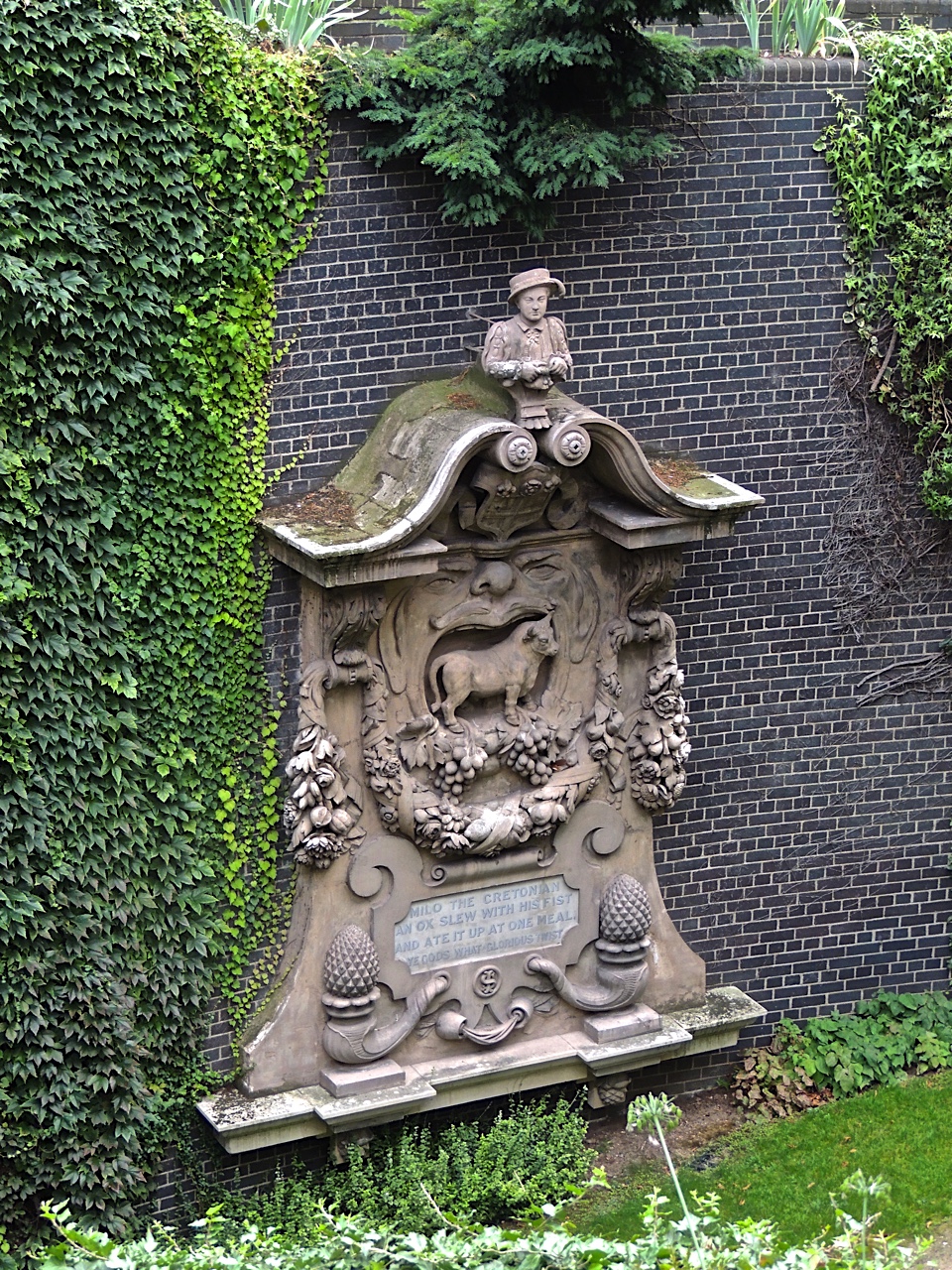
As I was leaving the museum I saw this rather interesting sculpted plaque located in a sort of garden courtyard.  I couldn't quite figure out what it was supposed to be depicting so I had to do a little research about it.
I learned that it supposedly commemorates the Bull and Mouth Inn which was demolished in 1830 to make way for the Queen's Hotel which in turn was demolished in 1888.  The face eating the bull is said to represent Milo of Croton, a Greek wrestler who rumor says carried a bull on his shoulders.

That is one piece of historic art that has a meaning which remains deeply buried in the folds of time.

Sunday, May 28, 2017

The Narrow Streets of Siena


My hotel in Siena was just outside the walled center of the city so my very first glimpse of Siena although beautiful and oozing with Tuscan charm, gave no hint of what I was going find beyond the gates into the ancient part of the city.


The streets were narrow and yet used by both pedestrians and vehicles.  Fortunately, drivers were careful as they rounded corners and eased their way through the streets.


Every turn on to another street revealed more buildings that have housed families for centuries and are still homes and businesses.


Beautifully adorned grocery stores tempted me with perfect looking fruits and vegetables not to mention the pasta of every shape and size.  If I'd had a kitchen available to me I would have certainly picked up the fresh ingredients for a lovely Tuscan dinner.


Siena has been declared a UNESCO world heritage site and all you have to do is walk these narrow streets to see why.  It was the first place settled by the Etruscans between 900 and 400 BC.  Imagine that!  At one time in its history, it was home to 50,000 people.


I found my self wondering what it must have been like to live in the city at that time and every now and then I would run across a person in period clothing adding flavor to my growing imagination.


Siena is the kind of place where it's easy to feel what it must have been like to live in a city more than a thousand years ago.  I'm sure we twenty-first century humans would find it impossible but to those living there at that time it was the normal way of life.

Siena is a magical place that I'd love to explore again one day.

Sunday, May 21, 2017

Banking on Lunch in the City


After a busy morning walking the wonderful streets of London, my legs told me it was time to sit and relax for a while.  So while wandering along among all those tall and exotic looking buildings in the City of London, I was keeping my eye out for a good place to have lunch and take a break from all that walking.

When I peeked in the open door of The Counting House I knew I had found the perfect spot.

How can a pub be so gorgeous?


I soon learned that what was now a pub was once a bank dating back to 1893.  It was once the home of Prescott's Bank to be exact.  And, the history of the place doesn't stop there.  The original bank building was built on the site of an old Roman basilica with the foundations of this building resting on ancient Roman walls.


I ordered a delicious pasta dish from a very friendly waitress who was happy to fill me in on some of the history of the place.


The bar of the pub sits in the center of the room and was once the place where banking transactions took place.  The domed glass ceiling and the chandeliers all date back from it's financial past.  I especially liked the supports that held up the antique brass foot rail around the bar.


The Counting House proved to be a great place for lunch with a splendid history and some very beautiful furnishings.  Squeezed in between all those glass and steel towers that the City of London is famous for, it was a gem of old world charm.