Sunday, June 19, 2016

A Drive in the Mountains


No matter where it is, a drive in the mountains is always inspirational.  The tall trees and the green hills are a perfect backdrop to some adventurous explorations.  When I visited Italy a few years ago, I spent one day doing exactly that, exploring the Dolomites of northern Italy.  Driving along the road I passed beautiful villages pressed against the mountains as though they were hugging the land in appreciation.


Some villages clambered up the side of a hill and then capped the effort with a tall tower above it all.


In other places a castle could be spotted sitting in a high enough position to watch everything that passes by its doors.


Some villages brought images of ski slopes and resorts to mind with their Alpine chalets and an occasional chair-lift.


Tiny churches clutched the edge of the road with their steeples appearing to mimic the rocky peaks behind them.


Every now and then a group of brown cows would gather at the side of the road with curious stares to go along with the clanging of their cow-bells.


Some settlements sit so precariously on the side of a mountain that I wondered how they keep from sliding down especially when the snows come.


Rounding the curves in the road always brought some new vista to admire.  Sometimes it's a green valley, sometimes the steep slope of the mountain and sometimes a picturesque village that requires a quick stop to admire and photograph the scene.


Above it all are the jagged, snow-covered peaks framed by the soft green of the pine trees swaying in the mountain breeze.  The magnitude of these grand mountains are both awe inspiring and humbling to me and following the winding roads through them was an adventure I will never forget.

Sunday, June 12, 2016

Arriving in Rome


I am very good with maps.  Once I have my sense of direction, the map will help me to identify where I am and where to turn next.  But, first I have to get my sense of direction.  That is why when I arrive in a new city that I've never been to before, I first ask for someone at my hotel to point me in the right direction using my map as the guide and then I set out for a walk to make sure I've got my bearings.  That is exactly what I did when I arrived in Rome Italy for the very first time.


After a hair-raising ride in a taxi from the airport and settling into my hotel room, using my map, I asked the man at the front desk to point me in the right direction and off I went.  That first walk around a new city it always a bit of an adventure.

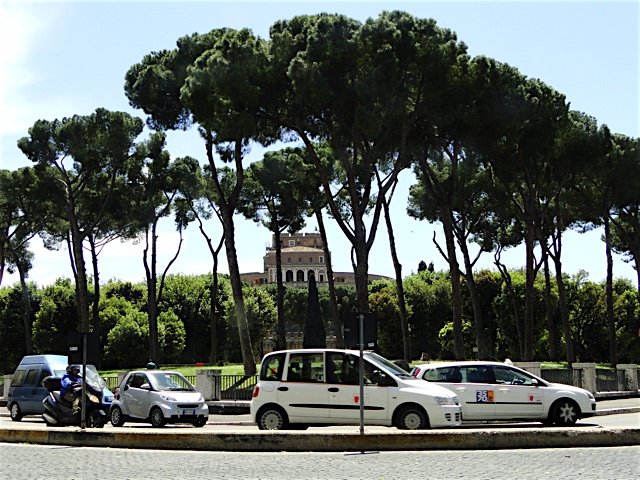
I found myself in awe of the tall umbrella pine trees that lined the streets and set the tone for my explorations.

I came to a monument that was not identified on my map but, the name on the plinth was Camillo Benso di Cavour, a statesmen who was instrumental in the unification of Italy.


A little further along I came to this rather grand building and my map called it the Palace of Justice.  It houses the Supreme Court of Cassation, the highest court of appeal in the country.


I learned that it was built in 1888 and is completely covered in travertine limestone.  I also learned that it's popular name among locals is "Palazzaccio" or "the bad palace".  I guess the idea is you don't wan't to end up here.


The building is topped with a quadriga sculpted by Ettore Ximenez of Palermo.  What is a "quadriga" you ask?  It's a word that describes a statue consisting of a chariot pulled by four horses.  I've seen many such statues before but had never seen that word before seeing it in my guide book.


Before long I had made my way to the Tiber River and a stroll along the river under the shade of the trees was a special treat for this first time visitor.


I passed simple bridges and bridges adorned with statues.  And when I crossed the bridge I found more places to explore and more statues and monuments to admire.


I found another bridge to cross back, confident that I had a good idea of how to follow my map and arrive at the places I wanted to see.  It was time to head back to the hotel and freshen up for a long evening walk and my very first Italian dinner! I'll post more about walking and eating in Rome another time.

Sunday, June 5, 2016

Island Life


I recently saw a quote about Balboa Island, an island community of Newport Beach in California.  "Welcome to Balboa Island where the cats are numerous, fat and lazy, the dogs are spoiled, the houses are quaint and enchanting, and the living is creative and carefree."  I couldn't have summed it up any better.

Passing the flower laden light posts that line the single bridge on to the island, I enter the island's business district.  It's a good place to start the walk and peek into the eclectic collection of shops and the interesting array of restaurants.  I might stop for a milkshake or if I'm good, an iced tea to take along on my walk.


On my summer trips to California, a trip to Balboa Island is always a welcome diversion and the long walk all the way around the island is a healthy way to work off those fine-dining calories.  The island is busting at the seams with homes squeezed on to narrow lots.  I'm betting that most residents could shake hands with their neighbors out the windows of their houses.


That doesn't mean you can't build a mansion on one of those lots.  It is possible as evidenced by the one in the photo to the left.


On my last walk around the island, there were a lot of interesting things that caught my eye.  I saw mailboxes with a marine theme.


I ran into a former President and he gave me a friendly wave.


I lost count of all the picket fences.


And, I admired all the ocean-themed weather vanes.


Most of the house have front patios where residents can watch the boats as they slowly enter the marina.


Many of the homes share docks where they can party both on and off the boat.


Strolling around the island is an entertaining way to enjoy the California weather and get a taste of ocean-side living.  And, it's the perfect way to escape the Arizona heat during the month of August.  That is about the time we desert dwellers need a break from those soaring temperatures.

Sunday, May 29, 2016

An Arizona Mission


One of my favorite places to visit in Southern Arizona is Mission San Jose de Tumacacori.  It's ragged and crumbling beauty has drawn me (and my camera) to its location many times.  I can still remember my very first visit and how I rounded a corner in the visitor's center and was met with a view out a window that looked more like an oil painting than the reality it was.


Tumacacori is a Franciscan mission built in the 18th century and taking it's name from an even earlier mission that was founded by Father Eusebio Kino in 1691.  That first mission was abandoned and this newer one was built in its place.


Today the mission stands in ruins that have been preserved as the Tumacacori National Historic Park.


The roof of the mission was destroyed many years ago and the effects of weather and scavengers means that little remains of the original interior.  However, when I visit I can still see faint paintings on the walls as in the photo above.


This depiction of what the inside looked like when it was first built gives the guest an idea of the beauty of the space.  A replacement roof was added and the structure was stabilized when restoration began back in the early 20th century.


The inside is dark and cool and a little haunting.  You can see remains of the altar, nave and the choir loft as you walk around the interior.


I like the walk around the exterior of the church and compose photos that combine the rough hewn walls of the church and the outer buildings and that brilliant blue Arizona sky.  If I'm lucky like I was on the day these photos were taken, the sky will be full of giant white clouds to add even more contrast to my images.

Sunday, May 22, 2016

Another Chicago Landmark


Anyone who has been to Chicago knows that it is a city full of architectural gems.  One of those gems is the neo-gothic Chicago Tribune Building located on Michigan Ave.


Completed in 1925, it was designed by New York architects John Mead Howells and Raymond Hood who won the design competition that was sponsored by the newspaper.


A statue of Nathan Hale stands in front of the entrance like a proud sentry on guard.


One of my favorite features of this grand old building are the pieces of famous structures that have been imbedded into the sides of the building at the street level.  When the building was being constructed, the Tribune asked their globe-trotting reporters to bring back pieces from the places they had visited on reporting missions.  In this photo we see a piece from Lincoln's Home in Springfield and a stone from Powder Tower in Riga Latvia.


I especially liked this piece from the Temple in the Forbidden City in Beijing.  There are 149 pieces set into the stone walls from all over the world.  The most recent piece added is a piece from the World Trade Center.  Every time I visit Chicago, I always stop here and look for new artifacts from far flung places.

Sunday, May 15, 2016

The Art Collection


The undisputed star of the Huntington Library collections has got to be Thomas Gainsborough's "The Blue Boy".


The painting sits in a huge gallery room at the center of one wall.  This room is full of treasures but as you can see from the people in this photo, everyone seems to congregate in the direction of "The Blue Boy".


At the other end of the gallery and facing "The Blue Boy" is "Pinkie" by Thomas Lawrence.  She appears to be the perfect companion to her partner across the room.


The Huntington collection also contains some more contemporary pieces Like "The Long Leg" by Edward Hopper (above).  Listening to the museum's audio guide, this painting is described by Steve Martin who is a huge fan of Edward Hopper and a well known art collector (as well as actor) himself.


Another contemporary piece is "Ghost Ranch Cliffs" by Georgia O'Keeffe.  


There are a number of sculptures in the collection as well.  This one by Harriet Goodhue Hosmer is called "Zenobia in Chains".  It's a sculpture of the third century queen of Palmyra, Zenobia.  

As I said in my first post about the Huntington Library & Gardens, there is way too much to see in one day.  I'll have to go back again for another stroll through the gardens and spin around the galleries.  

Sunday, May 8, 2016

The Huntington


Henry Edwards Huntington was introduced to the railroad business by his uncle who was one of the owners of the Central Pacific Railroad.  Some twenty years later, he was managing the Southern Pacific Railroad and several other business operations and he purchased an estate in San Marino California and began to fill the home with his collections of books and art.  He retired from work at the age of 60 so that he and his wife Arabella could devote their full attention to their collections.


In this post, we will take a look inside what was once his home and take a peek at just a tiny fraction of the collectables that can be found inside.


Beautifully crafted furniture shares space with amazing works of art and breathtaking collections of porcelain.


This Wedgewood urn was particularly eye catching.


Arabella must have had a special attraction to fine porcelain because her collection included some of the most beautiful and unique pieces I've ever seen.  Above is a piece manufactured by Royal Porcelain Manufactory in Sevres France.  It's called Vase a Tetes de Bouc (Vase with Goat Heads).


The details on this gorgeous piece are remarkable and the soft colors of pink and blue and green are very attractive.


In 1919, the Huntingtons signed an indenture to leave their estate and collections to a non-profit educational trust creating The Huntington Library, Art Collections and Botanical Gardens which now hosts over 500,000 visitors per year.

Next week I'll feature some of the art works in the Huntington collections.  It contains one of the world's most famous paintings.