Photography and travel are my two passions. This blog will feature photos from my travels and little anecdotes about my experiences and discoveries.
Sunday, March 12, 2017
A Resort with Some History
One recent July, I decided to take a long drive around the very southern part of my state of Arizona. I traveled to many towns that I don't visit very often. Late in the afternoon I pulled into the Tubac Golf Resort on the spur of the moment and checked to see if they had any rooms available. They did and at summer rates that were too good to pass up. So, after settling in to my rather sumptuous room, I decided to do a little exploring.
At the time, I didn't realize that I had stumbled on to such a historic place. The resort sits on a piece of property that was once part of a very large ranch and that ranch dates back to 1789. In America, that's a very long time ago. The land was granted to Don Torbio de Otero by King Charles IV of Spain. This was at a time when the Spanish ruled parts of the southern half of our state and Mexico.
In 1853 the land was brought into the United States as part of the Gadsden Purchase. By this time, the ranch was being run by Otero's grandson who traveled back to Mexico and learned how to raise cattle. He returned to the ranch and introduced cattle to the property, making the ranch the home to one of the largest cattle empires in Arizona.
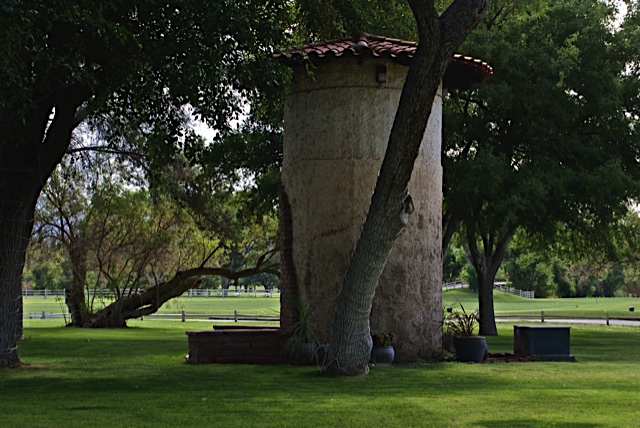
Remnants of the ranching days still remain on the property like the above silo and old wagons and other relics of the era. The property remained in the Otero family until 1941.
In 1959, a group of businessmen headed by singing legend Bing Crosby, acquired the ranch and began the operation that is today the Tubac Golf Resort and Spa.
The new owners were careful to preserve the historic integrity of the land and buildings on it. Today, the influence of the original owners can be felt throughout the property.
When I went to dinner at one of the restaurants on the property, I had a spectacular view of the golf course and the beautiful mountains in the distance. I'm not a golfer but, I can see why any avid golfer would be drawn to such a beautiful place to play the game.
I would have to warn those golfers that they will have to play around a few cattle who still roam the property. I've been told that the cattle tolerate the golfers and the golfers are careful not to drive any balls in their direction.
Sunday, March 5, 2017
Orange County Gem
If you find yourself in Orange County California with some time to spare, I might suggest you check out this gem of a museum in Santa Ana. The Bowers Museum was introduced to me by my good friends Julie and Dave. They are members and visit the museum often.
My admiration for the place began on the outside when I saw these fantastically tall pine trees on the grounds around the building. I'm not sure what variety they are but they are certainly a unique breed.
I also thought it was amusing to see a sign warning people to watch out for falling pine cones. I tried to spot one but I couldn't see any among the foliage. I wonder just how big they are. I know for a fact that the pine cones of the giant sequoia trees are tiny things about the size of a child's fist.
The museum is known for it's huge collection of Pacific Islands artifacts and highlights three cultural regions of Oceania; Micronesia, Melanesia, and Polynesia.
Here's an attractive fellow I admired. He is called a Flute Stopper and he's designed to convey an intimidating power which he seems to be doing quite well.
He is from the Biwat people who were feared throughout the region for their cannibalism and warrior ways. Surely a group not to be trifled with.
The collections features thousands of pieces created by the Pacific Islands people. It was extremely interesting to see the differences in the craftsmanship of the different tribal communities and to learn about the customs of each group of people.
The oldest part of the museum was built in 1932 and contains displays from the Americas. The land for the museum was donated to the city of Santa Ana by Ada Elvira Bowers and her husband Charles W. Bowers who was a citrus grower and land developer of the era. In addition to the land, they donated $100,000 to begin the building process.
The ceiling in this particular room was a piece of artwork in itself. The carved wood seems to drip from the ceiling down the walls of the room.
In an adjacent room, this painted and carved ceiling stole the show.
Here is a close-up view of the center panel of the ceiling.
Visitors are greeted by this statue of the Spanish explorer, Juan Cabrillo as they enter the museum through the courtyard. It was placed there in 1936 and was the work of the artist Ada Mae Sharpless.
In addition to the vast Oceania collection, the museum is also known for it's traveling exhibits that appear throughout the year. That's always a great way for people in the nearby community to see things from foreign museums around the world.
Sunday, February 26, 2017
The British Museum
The British Museum is one of those places where a single article or in this case, blog post is simply not enough. It is right up there with the premier museums of the world and is one of London's most visited attractions drawing in excess of six million visitors a year.
The museum's entrance on Great Russell Street shows off the neoclassical architecture in all its magnificent grandeur. The grand entrance was intended to reflect the wondrous objects housed inside and I think it does that rather well.
Passing through that grand facade into the museum, you find yourself in the area called Watson Hall and its classical Greek design.
A few steps past Watson Hall brings you to the Great Court, a truly stunning achievement in architectural design by Norman Foster. The centerpiece for the museum was completed in 2000.
The soaring glass and steel ceiling covers what was once a courtyard that had become unusable because of a structure to house historic books that was built at its core. Those books are now at home at the British Library and this space became ripe for huge remodeling.
Mr. Foster did a spectacular job making this space the center focal point for the entire museum and it's vast collection.
Among the museum's most famous possessions is this statue of Ramesses II dating back to 1270BC and weighing in at over 7 tons.
Of course there are Egyptian mummies and the ornate sarcophagi to go with them.
In fact, the Egyptian collection is one of the most popular in the museum. If you are there on a Sunday like I was, you will find the rooms full of visitors.
I enjoyed walking through the mummies and statues but, I was fascinated with some of the smaller treasures to be found in the quieter rooms. I posted about the The Lewis Chessman in another post.
To the right is a gilt Bacchus sitting atop a barrel of wine.
And, on the left is a glazed ceramic vase depicting Hercules embracing Deiarina after rescuing her from the centaur Nessus.
One thing that always impresses me is seeing ancient glass creations that have survived the centuries in seemingly perfect condition.
This one is described as gilded enameled glass probably coming from Syria or Egypt but mounted into a goblet in France somewhere around 1200.
I spent the better part of a day wandering around this boundless repository. I even stopped for lunch at the restaurant under that splendid glass ceiling.
There are so many fabulous museums in the city of London, I don't think I'd ever run out of things to see and things to learn if I lived there my entire life.
This post is linked to Through My Lens.
Sunday, February 19, 2017
It's Laundry Day
When I was a child I used to help my mother hang the clothes out to dry. She had two lines strung up in our back yard and we would pin the clothes to the line with those old fashioned wooden clothespins. We don't often see clothes hung out to dry any longer in the cities of the U.S. When I traveled to Italy, I was reminded of those days almost everywhere I went. I saw the above clothes line from my hotel window in Florence.
In Siena, I saw laundry hanging against those gorgeous "siena" walls.
In Venice sometimes clothes were hung out across the canal...
...other times they were hung against a house.
In Burano I found some bright laundry against those brightly painted houses.
Everyone in Burano seemed to have lines outside their second floor windows.
There is just something charming about seeing lines of clothes out to dry!
Sunday, February 12, 2017
Inspired by Photography
Last week I told you about my eclectic list of sites to see while visiting London. Today I'll show you another of those rather unique locations. This one happens to be a home furnishings store. No, I wasn't on the lookout for a hard to find table or chair, it was something in the store itself that I found interesting. You see, I had seen a number of photographs of the most picturesque spiral staircase that I had ever seen and I wanted a chance to photograph it for myself.
I made my way to Tottenham Court Road to find the store. The store is called Heal's and it specializes in modern home furnishings and accessories. I have to say, the store itself was quite appealing with an array of beautiful things to look at.
There were quite a lot of sparkly things in this showroom.
But, it was the staircase I came for and when I found it, I could see that it was every bit as beautiful as all the photos I'd seen. It's called the Brewer Staircase and it whirls and spins in a mesmerizing pattern. The stairs were originally designed by Cecil Brewer in 1916. Today visitors from all over the world stop in just to see it. I climbed the stairs all the way to the top so I could take photos looking down.
And I went all the way to the bottom so I could take photos looking up.
I even took one looking to the side.
No matter what view point I chose, it looked stunning from every angle.
I guess when it comes right down to it, I've always been inspired by photos of places and things. If I see something interesting in a book, on a postcard, TV show or on my computer screen, I tend to write it down and do some research. It just might end up on my must-see list!
Sunday, February 5, 2017
Broadcasting House
Some might say that I'm a tourist with a varied and eclectic interest in places to seek out. Others might say I have a whacky list of interests that wouldn't appeal to most people. Both are probably true. Maybe that's why I travel on my own so well. In fact, even when I travel with friends, I tend to go off on my own for at least part of the time. On my last trip to London, I had a long list of places I wanted to visit and I'm happy to say, I made it to most of them. There are still a few lurking on the list for next time.
One of those places on my list was Broadcasting House, the home of the BBC. Why, you might ask? It all stems from a comedy program I found on Netflix a year or so ago called "W1A". It was a hilarious comedy of yarns about managing forces at Broadcasting House.
I'm sure that real life work at the BBC is much more placid than the show portrays....or is it? Regardless, the show made me curious to see the building for myself. The building is a combination of old and new; the old part having been built in 1932 and the new part completed in 2013. It now forms a sort of horseshoe shape around a central plaza.
Inside the lobby, there are displays relating to different BBC productions. I was excited to find Dr. Who's Tardis sitting in the lobby area. I tried to peek inside but it was locked. Too bad, I would have loved to take a spin around the universe.
After passing through a security checkpoint, I arrived at a visitors area where I could view all the activity in the Newsroom below.
After taking several photos, I noticed the "No Photography" sign on the glass.....oops! However, the security guards were a mere 10 feet away from me and none of them took notice.
If you are a fan of British comedy, I recommend the short series "W1A". It stars Hugh Bonneville (of Downton Abbey fame) and a cast of idiosyncratic characters I won't soon forget!
Sunday, January 29, 2017
Bond, James Bond
If you are a fan of James Bond movies, you might recognize this building. It was famously blown up in the movie "Skyfall". In reality, this building actually was attacked in September of 2000 when it was hit by a Russian-made anti-tank rocket. The attack only caused superficial damage but, the perpetrators were never captured. Thankfully, no such excitement happened on the day I stood across the Thames from the building and took a few photos.
This building is known as Vauxhall Cross and is the home of MI 6. It's no secret, everyone knows it. As you can easily see from the photos, the building is of a unique style. It was designed by architect Terry Farrell as an urban village. When I read that he was influenced by 1930's industrial modernist architecture along the river such as the Bankside and Battersea Power Stations, I couldn't really see a comparison. (Bankside Power Station is now the Tate Modern art museum.) Then I read further that he was also influenced by Aztec and Mayan religious temples. Ahhh...that I can see.
Farrell's design has received both praise and disdain. Some have called it "a classical composition with a possible sense of humor" while others say it's too Gotham City for their taste.
Since London is a city with some of the most unique architecture anywhere in the world, I think it fits right in! What do you think?
Subscribe to:
Posts (Atom)


